

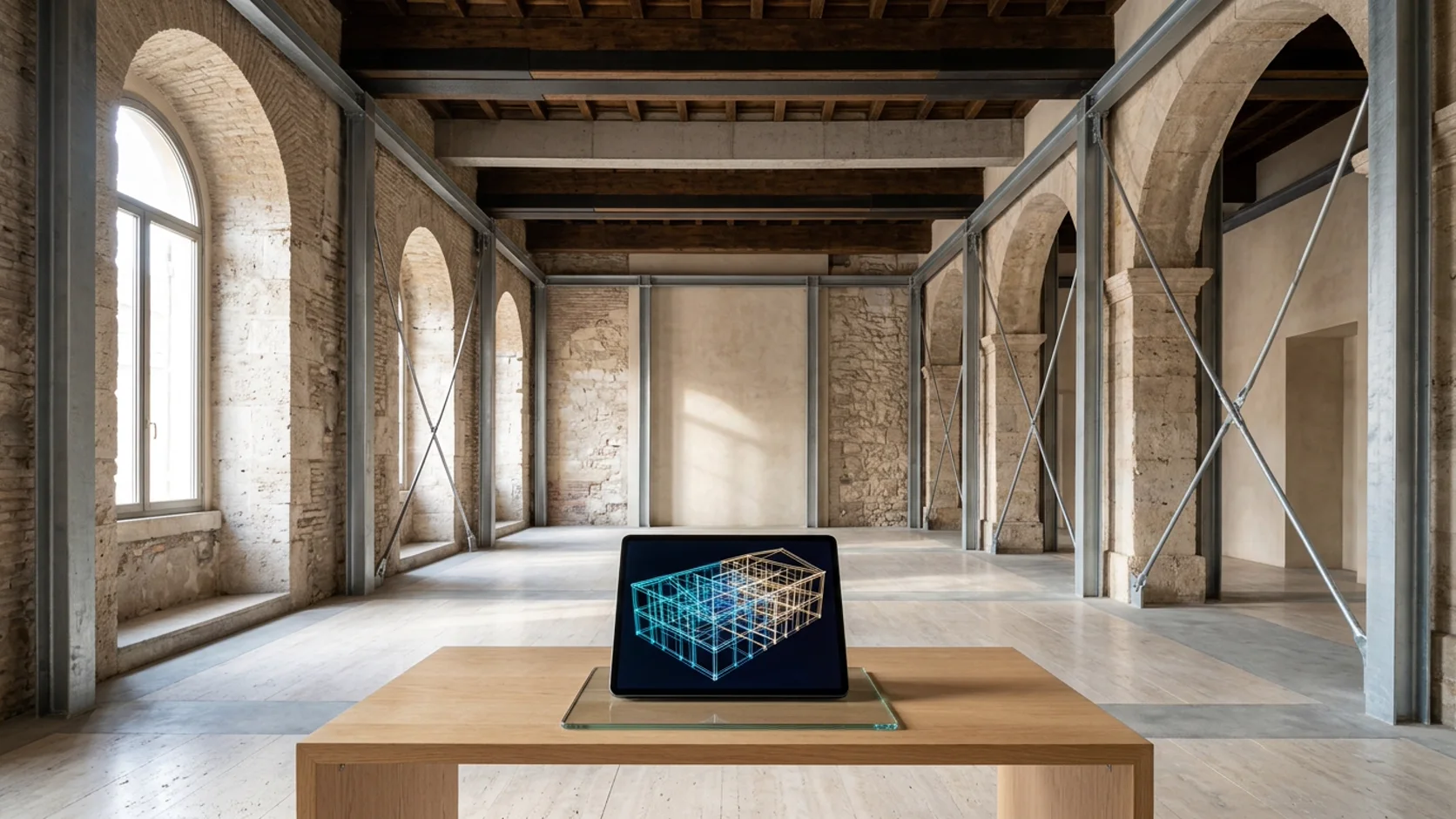
Whenever a renovation in Italy touches load-bearing walls, floor slabs, roofs, or foundations, a municipal building permit (CILA or SCIA) is not enough: Italian law requires a dedicated structural and seismic filing with the regional Civil Engineering Authority — the Genio Civile. This engineering guide by Studio Ing. Fabio Balcaici explains how NTC 2018 seismic permitting works for homeowners, architects, and international investors in Rome, Florence, and Frosinone, including the 2026 updates on OpenGenio Lazio and Tuscany PORTOS and the advantages of openBIM structural engineering.
1. What Is the Genio Civile and When Is a Seismic Permit Mandatory?
In Italy, the Genio Civile is the regional structural engineering authority responsible for verifying static and seismic safety under Articles 65, 93, 94, and 94-bis of Presidential Decree D.P.R. 380/2001 (Italy's Consolidated Construction Act) and the national Technical Standards for Construction — NTC 2018 (Ministerial Decree 17 January 2018 and Circular No. 7/2019).
Because Rome, Frosinone, and Florence all fall within active seismic zones (Seismic Zones 1, 2, or 3), Article 94-bis classifies structural interventions into three legal regimes:
- "Relevant" Structural Works (Interventi Rilevanti): Require formal prior written Seismic Authorization (Autorizzazione Sismica) from the Genio Civile before any structural work may begin on site (e.g., new builds or full seismic retrofits in High Seismic Zones 1–2, vertical extensions/additions, and strategic buildings).
- "Minor Relevance" Works (Interventi di Minore Rilevanza): Require a sworn digital Structural Deposit (Deposito Strutturale) signed by a chartered Italian structural engineer, allowing work to start upon filing receipt subject to random regional audits (e.g., opening a doorway in a load-bearing masonry wall with a steel portal frame, localized floor slab strengthening).
- "Non-Relevant" Works (Interventi Privi di Rilevanza): Minor non-structural or lightweight elements defined by regional lists that do not require a Genio Civile filing, though they must still comply with NTC 2018 safety rules.
2. Common Structural Renovations: Permit Type & Typical Timelines
Coordinating municipal architectural permits with regional seismic filings is crucial to avoid costly site stoppages:
| Structural Work Type | NTC 2018 Classification | Genio Civile Procedure | Typical Lead Time |
|---|---|---|---|
| Opening a load-bearing wall (steel portal frame) | Local intervention (§ 8.4.1) | Structural Deposit (or Authorization in specific Zone 1/2 cases) | 15–30 days (survey, FEM calculation & digital filing) |
| Slab, beam, or column strengthening (FRP / FRCM) | Local or seismic improvement | Deposit or Seismic Authorization depending on seismic zone | 20–45 days (including material diagnostics) |
| Vertical extension / loft addition (sopraelevazione) | Full seismic upgrade (§ 8.4.3) | Prior written Seismic Authorization mandatory | 45–90 days (regional technical review & approval) |
| New construction (RC, steel, CLT timber) | New structure (Ch. 4–7) | Seismic Authorization (Zones 1–2) or Deposit (Zone 3) | 30–60 days following geological/geotechnical report |
| Retroactive seismic regularization ("Salva Casa") | Structural compliance amnesty | Dedicated OpenGenio Lazio / Tuscany PORTOS amnesty path | 30–90 days depending on discrepancy type |
3. Lazio Region — OpenGenio Portal (Rome & Frosinone): 2026 Rules
Across Rome, Frosinone, and the entire Lazio region, structural filings are submitted exclusively through the OpenGenio digital platform. Key 2025–2026 operational updates include:
- Lazio Regional Regulation No. 9/2026: Volumetric review fees must now be calculated per individual structural unit, and PagoPA/MyPay fee payments must be settled strictly via the unique IUV payment code generated directly inside OpenGenio.
- 2026 ISTAT Fee Adjustment (Det. G16380/2025): Updated statutory filing and archiving tariffs took effect in January 2026.
- Salva Casa Seismic Regularizations (L.R. Lazio 12/2025): OpenGenio incorporates updated digital workflows for structural tolerances and retroactive seismic compliance linked to Italy's Salva Casa Building Amnesty Law (Law 105/2024).
4. Tuscany Region — PORTOS Portal (Florence & Tuscany): 2026 Rules
In Florence and across Tuscany, all seismic deposits and authorizations are processed through the regional PORTOS portal (with statutory fee payments via Tuscany's automated IRIS payment gateway).
Following Tuscany Regional Law No. 51/2025 (harmonizing Tuscany's urban planning law L.R. 65/2014 with the national Salva Casa reform), PORTOS now requires structural engineers filing seismic regularizations to classify the amnesty path consistently with the municipal permit — distinguishing between total discrepancy / unpermitted works, partial discrepancy / essential variations, and construction tolerances.
5. FEM Analysis, Mandatory BIM (D.Lgs. 209/2024) & Sismabonus Incentives
Combining finite element structural modeling (FEM) with openBIM (IFC) prevents site clashes between steel reinforcement frames, historic masonry, and modern MEP installations:
- Mandatory Public-Sector BIM Threshold (> €2 Million): Under Italy's Public Contracts Code corrective decree (D.Lgs. 209/2024 amending D.Lgs. 36/2023), since January 1, 2025 digital information management (CDE/ACDat, BIM execution specifications, IFC deliverables) is mandatory for public works exceeding €2 million — reinforced by Italy's new Green Public Procurement CAM Building Decree (D.M. 24 November 2025, effective February 2, 2026).
- Sismabonus Tax Deductions: Eligible seismic strengthening works in Seismic Zones 1, 2, and 3 qualify for Italy's Sismabonus tax deduction — 50% for primary residences / 36% for second homes and other properties up to €96,000 per unit over 10 annual installments (with the 2027 Budget Bill currently extending the 50%/36% rates through 2027 under Italy's new Consolidated Income Tax Act D.Lgs. 117/2026), provided the chartered structural engineer files Allegato B (D.M. 58/2017) together with the building permit.
For full details on our structural engineering capabilities, visit our dedicated Civil & Structural Engineering service page.
6. Frequently Asked Questions (FAQ)
- 1. Do I need a Genio Civile filing to remove or open a load-bearing wall in an Italian apartment?
Yes. Opening or widening a passage in a load-bearing masonry or concrete wall requires a structural calculation for a steel portal frame (cerchiatura), a Genio Civile filing before site works start, structural works supervision (Direzione Lavori Strutturale), and a final structural completion report.
- 2. What is the difference between Seismic Authorization and Structural Deposit?
With a Seismic Authorization (required for "relevant" works under Art. 94-bis), structural work cannot begin until the regional office issues formal written approval. With a Structural Deposit ("minor relevance" works), work can start once the digital filing receipt is issued, subject to random sample checks.
- 3. Who is legally allowed to sign a Genio Civile structural project in Italy?
Only an Italian-licensed chartered civil/structural engineer (Ingegnere Civile/Strutturista) or qualified architect registered with the relevant Italian professional board (Ordine) and holding an Italian digital signature can sign and upload structural filings on OpenGenio Lazio or Tuscany PORTOS.
- 4. When is an independent Static Test (Collaudo Statico) required?
Under Article 67 of D.P.R. 380/2001 and NTC 2018, an independent Collaudo Statico (performed by a chartered engineer or architect registered for at least 10 years who was not involved in design or supervision) is mandatory for new constructions and seismic improvements/upgrades, and is required to obtain the final habitability certificate (Agibilità).
- 5. Can historic unpermitted structural modifications be regularized before buying or selling?
Yes. During pre-purchase technical due diligence or before a notary deed, a structural engineer can perform diagnostics and file a retroactive seismic compliance application on OpenGenio Lazio or PORTOS Tuscany coordinated with the municipal Salva Casa amnesty procedure.
- 6. Can international property owners claim the Italian Sismabonus?
Yes, provided the owner holds Italian taxable income (IRPEF/IRES) against which to offset the 10 annual tax installments, pays via compliant bank transfers (bonifico parlante), and files the mandatory structural seismic classification certificate (Allegato B) with the permit.
Request a Structural & Seismic Engineering Consultation
Planning a structural renovation, seismic retrofit, or pre-purchase structural survey in Rome, Florence, or Frosinone? Studio Ing. Fabio Balcaici provides turnkey bilingual engineering support — from 3D laser scanning and BIM/FEM calculations to OpenGenio Lazio / PORTOS Tuscany filings and final static testing.
Email us at